
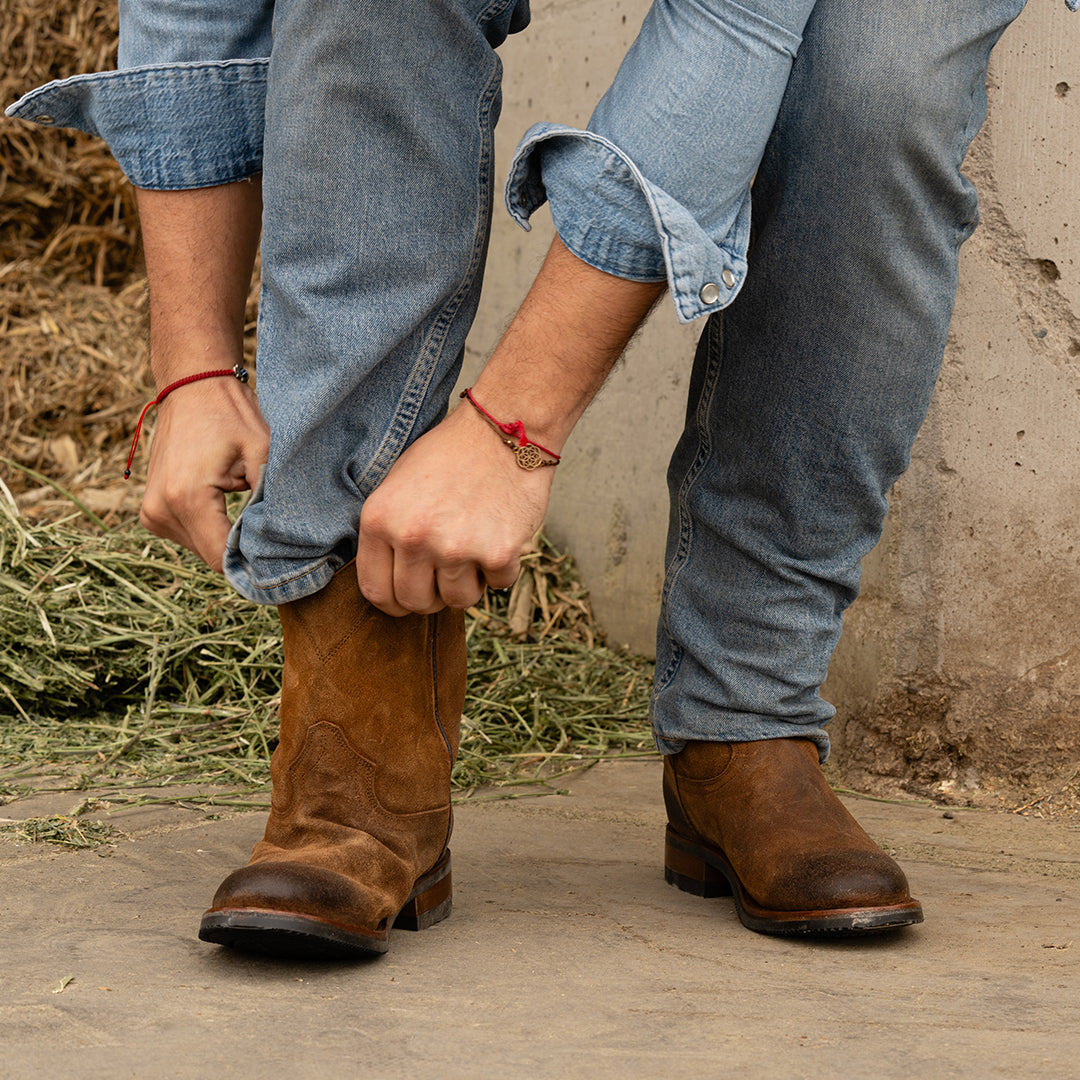
How should your boots fit? Your guide to the perfect fit.
Key points to consider:
Your heel should have no more than half an inch of clearance and should never rub against the back of the boot. The sides of your foot shouldn't feel tight. Leave an inch of room for your toes, as this allows your feet to expand and swell throughout the day without slipping inside the boot.
5 Key Considerations for Finding Boots That Fit You Perfectly
1 Flexion Point
The most important consideration when buying a pair of boots (or deciding whether to keep the new ones you just bought) is the flex point. Go outside with your boots on and notice where they bend: this is the flex point.
This natural crease should align with the place where your foot also flexes, that is, where your toes and the front of your foot meet.
2 The Heel
In most cases (if you're buying a quality pair of boots), the shoehorn might be a little uncomfortable. This is normal, as long as your heel moves slightly without any jarring. If it's more than that when you walk, go down a size. Or, if you notice your heel is sitting above the shoehorn, consider changing the insoles to a thinner pair. If that doesn't improve the fit, it might be a good idea to consider a different size.
Boots have a break-in period, and during that time, the insole and leather mold to your foot. Often, you'll find that it takes a few weeks for boots to truly feel comfortable.
3 The Width
Your foot is wider than you think.
Wait, what?
When you wake up, your feet are a certain width, and this is different at the end of the day. Walking and standing can cause your feet to swell up to half a size larger.
For that reason, we recommend trying on your boots in the afternoon when your feet are much closer to their largest size.
It's not that your feet get longer, but all that swelling can make the boots less comfortable.
Boots come in six widths, from B (extra narrow) to EEE (triple wide). While most manufacturers sell boots in the D (regular) and E (wide) ranges, you may need to find brands that offer an even wider range of widths.
Once again, if you feel tingling in your feet all day, your boots probably aren't wide enough. Perhaps you tried them on in the morning when your feet were narrower. Well, now you know to account for swelling; a perfect fit in the morning might feel very uncomfortable at night.
4 Socks
The socks you wear with your boots can be the deciding factor in whether your boots will fit correctly or not.
A pair of thick socks can change your size by up to half a size.
If you plan to wear your boots in winter and intend to wear thick socks, it's recommended to go up half a size for a good fit, as in summer these boots might be a bit loose with thinner socks.
5 Width at the tip
Imagine trying on a new pair of boots. What's the first thing we check to make sure you have the right fit?
You're probably imagining yourself pressing your thumb into the finger box.
It turns out that this is one of the least effective ways to determine if you have the correct fit.
It's far more important to ensure your boots fit perfectly in width and heel. These are the areas that can really damage your feet and ankles.
If you make sure your foot is supported but not constricted along the sides and the flex point matches your foot, you'll probably have an excellent fit at the toe anyway.


Leave a comment
All comments are moderated before being published.
This site is protected by hCaptcha and the hCaptcha Privacy Policy and Terms of Service apply.